A service site that sells itself: how we rebuilt dota2boosting.com
A calculator you can trust, an order page instead of a chat and boosters with public ratings. How we moved a long-running Dota 2 boosting service off WordPress and OpenCart onto our own code, and what changed for customers.

dota2boosting.com is a long-running Dota 2 MMR boosting service. For years it lived on two systems at once, WordPress and OpenCart, and every new service meant changes in both. In 2026 we rewrote the dota2boosting.com MMR boosting service from scratch on Laravel, and asked ourselves one question at every step: what is getting in the way of someone who is already ready to pay?
The price on the first screen
People come to a boosting site with one question: how much will this cost? So the calculator sits right on the service page. Server, role, current and target MMR, rank medals taken from the game's own files, a slider across the whole scale and extras with surcharges: duo queue, strictly solo, streaming, priority completion. The price and estimated time update instantly, and a promo code applies on the spot.
All nine services, from MMR boosting and calibration to Battle Cup and coaching, come from a single catalogue. Cards, menus and orders read from the same place, so a new option shows up everywhere at once rather than in three places one after another.
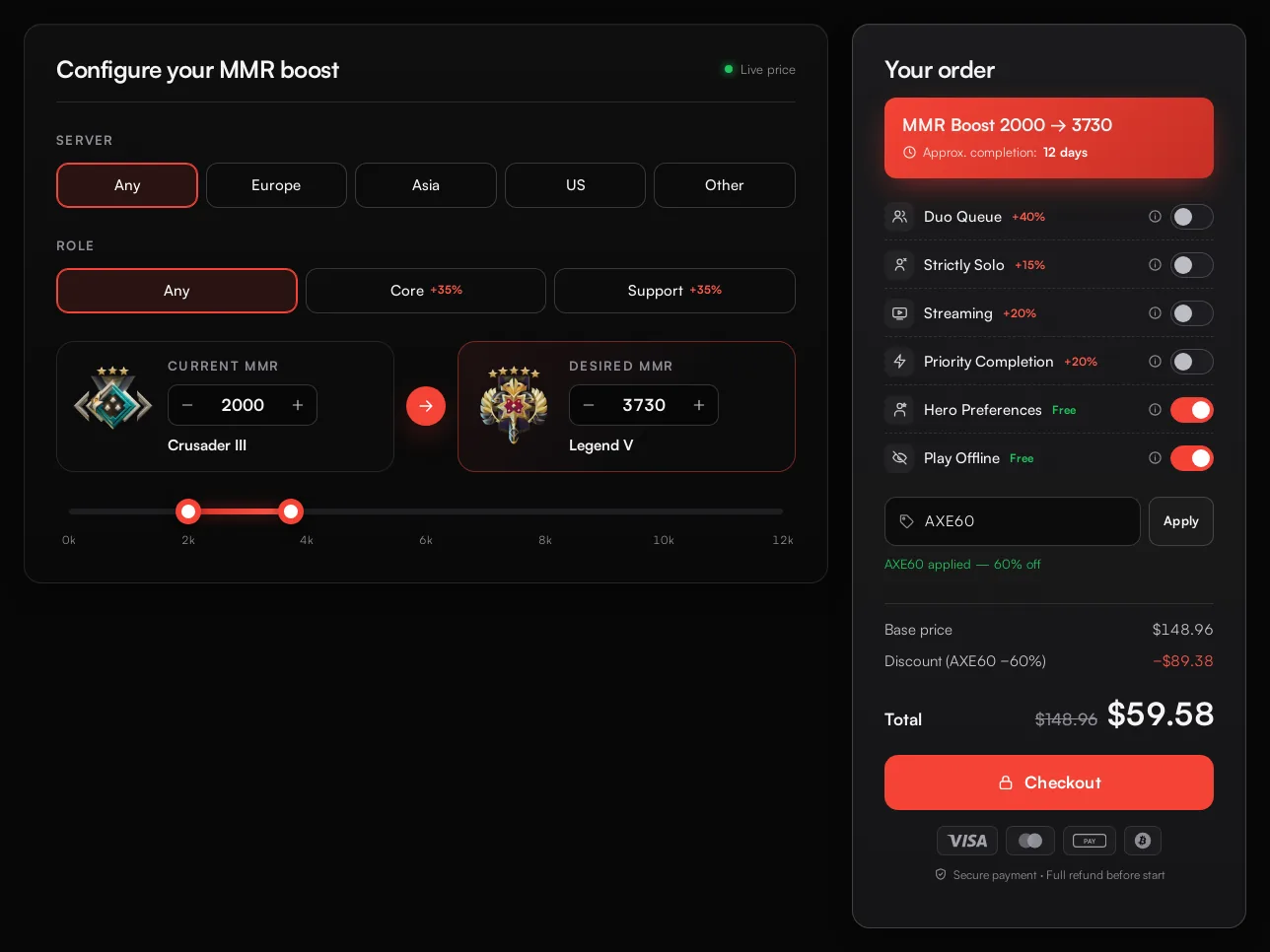
One price in the browser and on the invoice
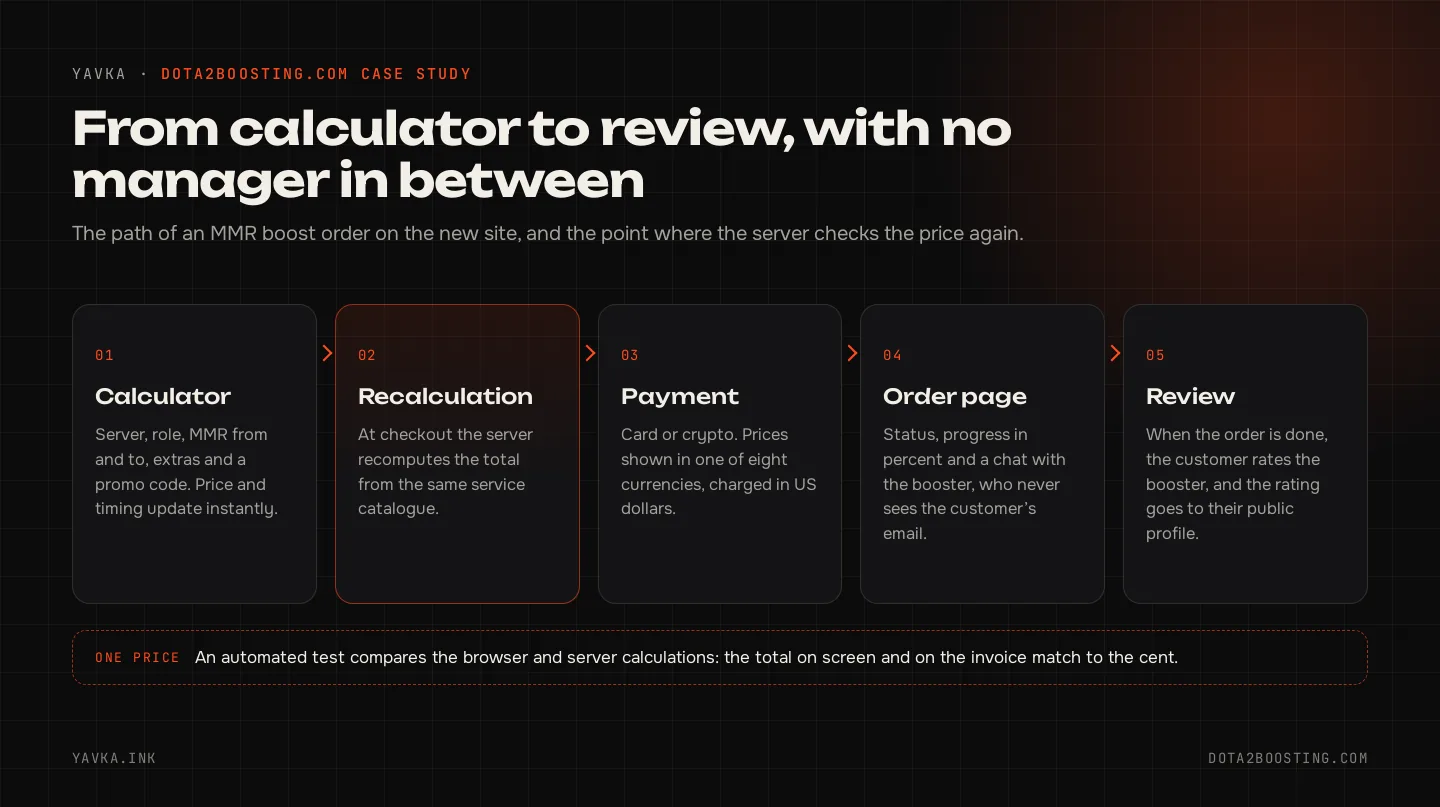
The calculator follows progressive enhancement: it is an ordinary form calculated by the server, and JavaScript only makes the calculation instant. The site works without scripts too. At checkout the server recomputes the total, and an automated test compares the browser and server calculations. The price on screen and on the invoice match to the cent, and there is no way to change it from the browser.
It sounds like a technical detail, but for conversion it is the whole game. The moment a customer sees a different total at the payment step, their trust in the service is gone, and the order goes with it.
Trust is built from small things
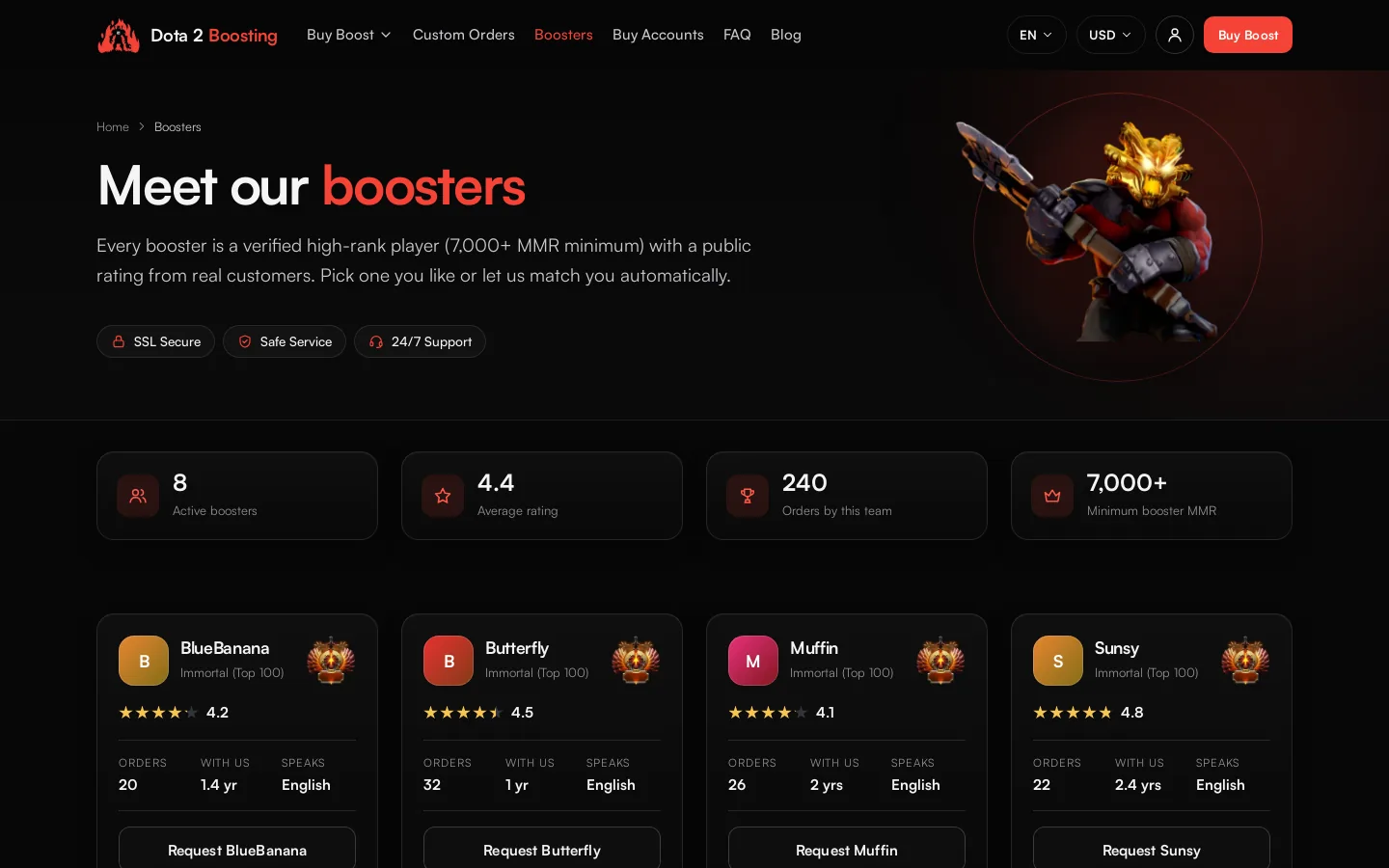
Boosting means a stranger plays on your account, and the site has to take that worry away. Every booster has a public profile: rank, rating from reviews, number of orders and the languages they speak. Customers can request a specific booster or let the service match one for them.
The Steam login is submitted through a protected form and stored encrypted. Every time it is revealed, that goes into a log, and once the order is closed the data is deleted. Reviews are moderated, and staff sign-in is protected with two-factor authentication.
After payment, an order page instead of silence
The most nervous moment for a customer comes right after they pay. So every order has its own page: status, progress in percent, a chat with the booster and a review once it is done. The booster works in their own dashboard: they take paid orders from a shared pool, log the current MMR (the percentage updates itself), pause or complete the job. They never see the customer's email, and their earnings are credited automatically when the order closes.
An account shop on the same rails
Ready-made accounts no longer live in a separate OpenCart store: they are sold through the same system as boosting. The catalogue filters by medal, an account is held for the buyer while they pay so it cannot be sold twice, and the login details open on the same order page. Custom orders cover anything non-standard, and regular customers get a referral programme with personal codes and a reward for each friend they bring.
Moving house without losing search
A new site is worth nothing if the old pages drop out of search. All 53 old WordPress and OpenCart addresses return a 301 to the new pages, the blog posts came across, and the old store's review counts were kept. The English, Russian and Ukrainian versions are linked with hreflang markup, and prices are shown in eight currencies at daily ECB rates. Payment is taken in US dollars, and the customer sees both amounts before paying.
What we took away from the project
- A calculator is not a widget, it is an agreement on price. The server has to calculate it.
- A service site sells peace of mind: booster profiles, careful handling of logins, an order page.
- A single service catalogue removes mismatches between the menu, the card and the invoice.
- A migration starts with a map of the old URLs, not with the design.
How the booster dashboard and the admin panel work, and how many automated tests guard the pricing, is in our dota2boosting.com case study. The service itself is still running at dota2boosting.com.